
Don’t Look Back
Five Nights At Teletubby Mansion

Choo Choo Charles Revenge
No, I’m not a Human 2
Hospital Aggression
Let Me Out

SCP-096 Modest







![Hello Kitty [HORROR] img](https://noimnotahumangames.com/wp-content/uploads/2026/08/hello-kitty-horror.jpg "Hello Kitty [HORROR]")


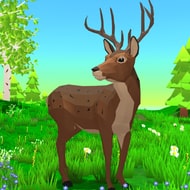
In Deer Simulator you start as a lone deer wandering an open forest with no herd, no mate, and no fawns yet to protect, which matters more than it first seems once the forest’s predators start taking notice. Everything that follows builds outward from that isolated starting point.
| Genre | Wildlife survival simulation |
| Playable Animal | Deer |
| Core Goal | Find a mate, raise fawns, avoid predators |
Locating a mate is the first real objective, and players quickly learn that wandering aimlessly through the forest rarely works as well as tracking the parts of the map where other deer tend to gather. Once a mate is found, the game shifts from solitary exploration into something closer to family management, with fawns eventually joining the herd and needing protection of their own.
New players often rush toward the nearest open area without paying attention to nearby predator activity, which can turn a simple search into an unplanned chase. Players with more patience tend to scout an area quietly first, since forests with visible predator tracks nearby rarely make safe places to linger.
Once fawns eventually arrive, that same open area stops being just a meeting point and becomes the first real test of whether a chosen spot was actually safe. Deer that settled near dense cover tend to fare better during those early days than ones that picked open, exposed ground for the sake of convenience.
Bears, wolves, and hunters all threaten a deer family in different ways, and the game rewards players who learn to distinguish between them rather than treating every threat identically. Wolves tend to hunt in ways that punish straying too far from the herd, bears are dangerous mostly at close range, and hunters introduce a different kind of risk tied to open sightlines rather than proximity.
Herd positioning: keeping fawns closer to the center of a moving group rather than at the edges, since predators typically target whichever animal is easiest to isolate rather than the strongest one.
Once fawns are part of the family, the calculation around movement changes entirely. A route that was perfectly safe for a lone deer can become genuinely risky once slower, more vulnerable fawns are following behind, and players who forget that distinction tend to lose a fawn to a predator they could have simply avoided.
Deer Simulator earns its tension from how quickly the stakes shift once a solitary animal becomes responsible for a family. Watching for bears, wolves, and hunters means something very different once fawns are involved, and that shift from simple wandering to genuine protection is what keeps the forest feeling dangerous long after the first mate has been found.
