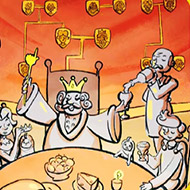
What does it actually mean to survive as a noble family for centuries rather than just one generation? Noble – Family Tree Sim answers that question by handing players one of four Noble Houses and then getting out of the way, letting marriages, births, and slow accumulated decisions determine whether that bloodline is still standing several generations later.
| Genre |
Multi-generational strategy simulation |
| Setting |
Medieval-inspired noble houses |
| Core Loop |
Marriage, inheritance, and genetic strategy across generations |
| Starting Houses |
Four, each with a distinct philosophy |
Choosing a House in Noble – Family Tree Sim
The first real decision players make isn’t a marriage or a building — it’s which of the four Noble Houses to represent, and that choice quietly shapes the tone of everything that follows. Each house carries its own motto and implied playstyle, and picking one is closer to picking a long-term identity than a simple starting bonus.
House Sapwood leans into fertility and expansion, treating a large family as its own kind of strength. House Wincestor centers influence, favoring alliances and political weight over raw numbers. House Krankhaus prizes health and resilience, playing a longer, steadier game rather than an explosive one. House Salestor bets on knowledge, treating information and planning as the real advantage over generations.
New players often pick based on which motto sounds most appealing without fully considering how differently each house plays in practice, and switching allegiance after several generations invested is rarely a clean or appealing option once a family tree has already taken shape.
Marriage as Strategy in Noble – Family Tree Sim
Marriage isn’t a side activity here; it’s the primary lever players pull to shape the family’s future. Every union is evaluated for more than romance — compatibility, inherited traits, and the political weight of joining with another house all factor into whether a specific marriage strengthens or weakens the family’s position going forward.
- Alliance marriages: pairing with rival houses to secure political stability rather than genetic advantage.
- Trait-focused marriages: prioritizing partners likely to produce favorable genetic combinations in the next generation.
- Defensive marriages: choosing unions specifically to protect against a family’s known weaknesses, whether that’s poor health or fragile influence.
Players quickly learn that a marriage which looks perfect on paper can still produce disappointing results once genetics get involved, since inherited traits don’t always combine the way careful planning would predict.
Timing matters as much as the pairing itself, since arranging a union too early or too late in a ruler’s life can shift how many heirs actually reach adulthood before the throne needs to pass on.
Genetics and Evolving Traits
The genetics system is what separates Noble – Family Tree Sim from a simpler dynasty-management game. Traits pass down through a biology-based system that simulates genotypes and phenotypes rather than randomly assigning bonuses to each new heir, which means two children from the same parents can turn out meaningfully different from one another.
Watching how traits combine and resurface across generations becomes its own kind of long-term puzzle. A trait that seemed to disappear in one generation can reappear two generations later once the right genetic combination lines up again, rewarding players who track lineage carefully rather than only reacting to the current generation’s traits.
Some players find this unpredictability the most compelling part of the entire game, since no two family trees ever develop identically. Others find the genetic randomness occasionally frustrating when a carefully planned marriage produces a weaker heir than expected despite good intentions on paper.
Surviving Across Centuries
The multi-century framing changes how every decision gets weighed. A choice that looks reasonable for the current generation can create serious problems two or three generations later, and Noble – Family Tree Sim expects players to think that far ahead rather than optimizing purely for whoever currently holds the title.
Political changes, health crises, and shifting alliances all test a house’s ability to adapt rather than simply persist. Players who treat each generation as an isolated puzzle tend to struggle more than those who plan with descendants several steps removed already in mind.
Legacy building becomes the real long-term goal once immediate survival stops feeling uncertain — securing titles, traits, and alliances not for the current heir but for whoever inherits the family name long after the player’s early decisions have been forgotten.
Player Types Across the Four Houses
Expansion-focused players gravitate toward Sapwood specifically because a larger family tree gives them more genetic material to experiment with across generations. Political players lean toward Wincestor, treating every marriage as a potential alliance rather than purely a genetic decision.
Resilience-focused players tend to prefer Krankhaus, valuing a family that survives hardship over one that expands quickly, while planning-oriented players gravitate toward Salestor, treating knowledge and foresight as the deciding advantage over centuries rather than any single generation’s strength.
None of these approaches are objectively correct, and the game rarely punishes players for picking a house that doesn’t match a min-max strategy, since each philosophy offers a genuinely different way to experience the same multi-century structure.
What Divides Players About Noble – Family Tree Sim
The pacing is the most commonly debated aspect. Players who enjoy slow, deliberate strategy appreciate how much weight each marriage and birth carries, while players expecting faster progression sometimes find the multi-century structure demands more patience than they initially expected from a genetics-driven simulation.
That slower pace is also precisely what makes long-term payoffs feel earned rather than automatic — a favorable trait resurfacing after several generations of careful planning tends to land differently than an instant reward would.
Noble – Family Tree Sim succeeds by treating a family tree as something genuinely alive, where House Sapwood’s fertility, Wincestor’s influence, Krankhaus’s resilience, and Salestor’s knowledge all offer distinct paths through the same core promise: survive long enough, and plan carefully enough, for a bloodline to actually mean something several centuries later.




















![Hello Kitty [HORROR] img](https://noimnotahumangames.com/wp-content/uploads/2026/08/hello-kitty-horror.jpg "Hello Kitty [HORROR]")