Lincoln Loud’s own house becomes the single most dangerous location in Five Nights at the Loud House, and that’s the detail new players underestimate most — the family members roaming the halls aren’t background characters here, they’re the entire threat the night shift is built around.
| Genre |
Camera-based survival horror |
| Setting |
The Loud family house |
| Core Mechanic |
Camera monitoring and route prediction |
Monitoring the Loud House at Night
The central objective revolves around tracking family members as they move between rooms and approach dangerous positions, with Lincoln Loud serving as the visual anchor of the setting even though the real challenge comes from monitoring several characters simultaneously. Looking away from a critical camera for too long can create a chain of mistakes that becomes difficult to recover from.
Many players entering for the first time spend too much time watching a single camera feed, when information only has value if it helps predict future movement. Knowing exactly where Lori Loud or Luna Loud currently stands matters less than understanding where either of them is likely to appear next.
One detail regular players recognize immediately is the specific dread of returning to a camera and finding a familiar position suddenly empty — that absence usually creates more anxiety than actually spotting movement, since it means someone has already relocated somewhere unseen.
Route Tracking Across Five Nights at the Loud House
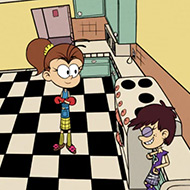
Different family members create different kinds of pressure. Leni Loud, Luna Loud, Lori Loud, and Lucy Loud may follow distinct routes or timing depending on the night, and learning those patterns becomes one of the most important skills for surviving longer shifts.
- Route tracking: predicting where a character will move next rather than reacting only to their current position.
- Fixed camera routines: reducing unnecessary checking by focusing on the locations most likely to matter.
- Pressure recognition: identifying threat windows where a specific character has reached a position requiring immediate attention.
Random camera switching rarely produces reliable results, since several family members can advance while attention stays divided, and survival-focused players tend to develop fixed routes rather than reacting purely on instinct.
Exploration-oriented players who try to memorize every character’s full route at once often find the mental load overwhelming, while players who focus on just one or two family members at a time tend to build reliable habits faster.
Why Later Nights Feel Different in Five Nights at the Loud House
As the nights progress, safe routines that worked comfortably early on start breaking down, and the increase in simultaneous threats is one reason later shifts feel dramatically different from the opening portion of the game. Once several Loud sisters begin moving within a narrow timeframe, even small mistakes can create serious problems.
One commonly debated topic among players involves difficulty balance — some enjoy the unpredictable pressure created by multiple active characters, while others feel certain nights lean too heavily on memorization rather than genuine reaction skill.
A delayed camera check that would have been harmless on an early night can be enough to let a threat reach a dangerous position once the family’s collective activity ramps up.
Why do later nights feel much harder than earlier ones?
Later nights increase pressure because more Loud family members become active simultaneously and movement opportunities occur more frequently, meaning a strategy that worked early may need real adjustment as overall activity increases.
What is route tracking, exactly?
Route tracking means following a character’s likely movement path rather than only reacting to their current position, using earlier camera information to predict where someone like Lucy Loud or Lori Loud will appear next.
Does watching every camera constantly improve survival odds?
Not really — success depends more on focusing attention on the most dangerous locations and recognizing threat windows than on trying to monitor every camera at once, which usually spreads attention too thin to react in time.
Five Nights at the Loud House stays memorable because familiar faces like Lincoln, Lori, and Lucy Loud become sources of constant tension rather than comic relief. Between route tracking, camera management, and pressure that escalates night after night, the game turns a sitcom household into a genuinely demanding survival test.


















![Hello Kitty [HORROR] img](https://noimnotahumangames.com/wp-content/uploads/2026/08/hello-kitty-horror.jpg "Hello Kitty [HORROR]")