No, I’m Not a Human: Usual Suspects Update challenges players with tense decision-making, observation, and controlled suspicion. The experience revolves around identifying inconsistencies in behavior while navigating unpredictable encounters. Each choice affects progression, forcing careful attention to dialogue cues, movement patterns, and situational details that often reveal hidden threats.
Suspicion-Driven Gameplay Flow
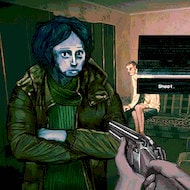
The core structure of No, I’m Not a Human: Usual Suspects Update revolves around investigation and reaction. Players interact with characters who may or may not be truthful, and the game rewards slow analysis rather than impulsive action. Progress depends on reading subtle signals and responding at the right moment.
- Dialogue inspection that reveals contradictions over time
- Context-based decisions influenced by environment changes
- Dynamic encounters where behavior shifts unexpectedly
- Risk-based progression with limited recovery options
Levels and Scenario Variation
Each level in No, I’m Not a Human: Usual Suspects Update introduces new layouts, suspect types, and interaction rules. Early sections focus on teaching recognition patterns, while later segments combine multiple threat indicators at once. The game ensures no two sessions feel identical by adjusting suspect behavior and response timing.
- Short investigative segments that escalate quickly
- Restricted information phases that limit visibility
- Multiple suspect clusters requiring prioritization
- Unstable outcomes based on earlier choices
Hidden Mechanics and Player Tricks
Many players ask whether No, I’m Not a Human: Usual Suspects Update includes exploitable systems. While there are no direct cheats, understanding internal mechanics can significantly improve results. Timing actions, delaying responses, and forcing repeated interactions can expose inconsistencies that are otherwise easy to miss.
- Repeated questioning to trigger altered responses
- Environmental resets that change suspect reactions
- Controlled delays to observe movement errors
- Pattern memorization across failed attempts
No, I’m Not a Human: Usual Suspects Update rewards patience and attention rather than speed. The game creates pressure through uncertainty, encouraging players to trust evidence instead of instinct. Each session becomes a learning process where failure adds knowledge, making future decisions more precise and controlled.


















![Hello Kitty [HORROR] img](https://noimnotahumangames.com/wp-content/uploads/2026/08/hello-kitty-horror.jpg "Hello Kitty [HORROR]")